
Asking “Will AI really take my job?” often confuses tasks, jobs, and organizations. Recent research is more nuanced than the alarmist videos: large models automate segments of work and boost some productivities, but they don’t mechanically replace entire professions. For an SMB, the hard part isn’t the tool: it’s identifying where AI creates value without diluting perceived expertise.
What the recent studies actually say
Three takeaways recur across the landmark reports:
- The IMF estimates that a large share of jobs in advanced economies is exposed to generative AI, but a significant portion of that exposure is complementary rather than substitutive — in other words, AI can increase worker efficiency rather than replace them (IMF 2024).
- The ILO concludes that the dominant effect of generative AI is task augmentation within jobs (not elimination), with stronger impacts on clerical/office jobs and on job quality (content, pace, autonomy) rather than on the total number of jobs (ILO 2023).
- The OECD observes that AI is advancing mostly on non‑routine cognitive tasks and, so far, we see more reorganization of roles than net destruction; the effect depends heavily on the adoption context and the skills involved (OECD 2023).
Finally, controlled experiments show concrete yet uneven gains: professional writing tasks get done faster with more consistent quality thanks to AI (Noy & Zhang, 2023), while support‑agent assistance can increase average productivity by ~15%, especially for less experienced workers (Brynjolfsson et al., 2023).
AI and jobs: distinguishing tasks, jobs, and the organization
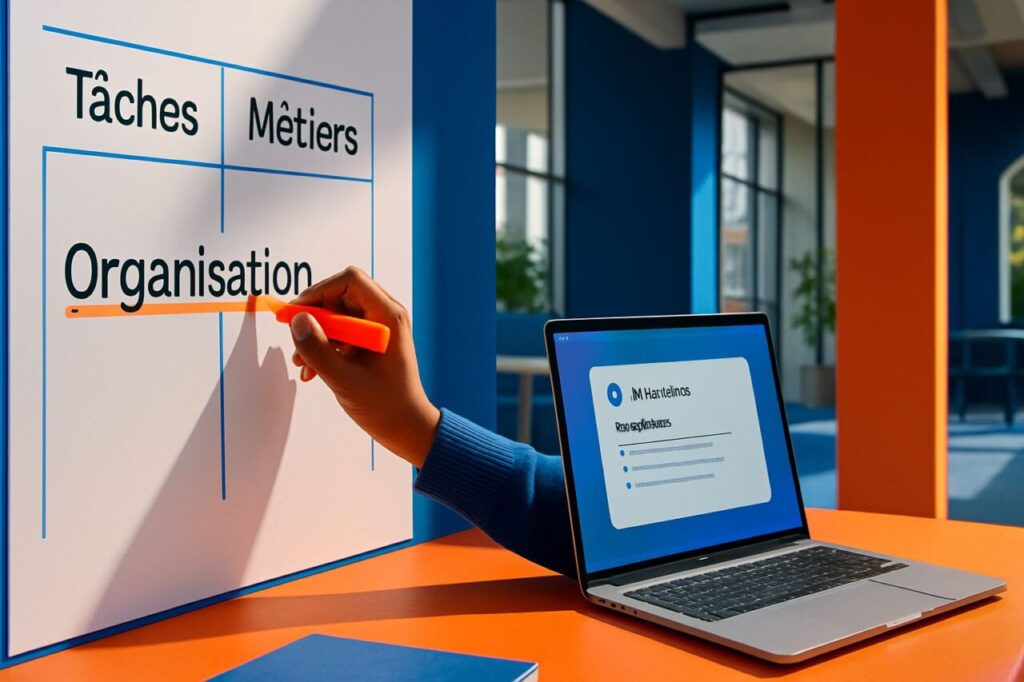
Saying “AI replaces a job” is rarely accurate. What it replaces (or complements) are tasks: summarizing, classifying, transcribing, drafting a first pass, extracting data, checking simple compliance. A job combines those tasks with other dimensions: relationship, negotiation, trade‑offs, legal responsibility, field knowledge, brand culture. And the organization (processes, tools, governance, reporting) conditions the real impact.
In an SMB, the right framing is to map actual work at three levels:
- Tasks: automatable, assisted, or strictly human?
- Job: where do judgment, ethics, situated creativity, and customer knowledge live?
- Organization: which flows (CRM, customer service, invoicing, marketing) must be redesigned so that AI increases value instead of creating friction?
Productivity: real gains, but not everywhere or for everyone

The observed gains concern mostly standardizable tasks with a clear quality benchmark. In the MIT study on professional writing, participants produced faster without lowering the average evaluation; AI also narrowed the gap between lower and higher performers (Noy & Zhang, 2023). On the customer‑service side, a copilot trained on thousands of interactions increased resolution speed, especially for juniors — evidence that AI can act as a tutor of good practices (Brynjolfsson et al., 2023).
Conversely, for tasks requiring contextual knowledge, multi‑step reasoning, or situated creativity, AI may produce quick but inadequate answers. The OECD points to a “reorganization of roles” effect: we shift human time toward verification, orchestration, and exceptions (OECD 2023).
Where are the concrete risks for an SMB?
We see three recurring risk families among the leaders we support:
- Automating the wrong thing: building complex scenarios on a fragile process or message. The result is amplified errors and a degraded customer experience. Technology doesn’t replace a marketing strategy.
- Eroding perceived value: fully delegating the production of “average” content that homogenizes your messaging and blurs your identity. Trust also rests on demonstrated distinctiveness — positioning, evidence, case studies.
- Underestimating industrialization costs: rights, compliance, data, supervision, integration with your CRM and automation. Unit gains on a single task aren’t enough if the overall flow remains artisanal.
Deciding what to automate: a simple, actionable grid
Before any tool, apply a “Marketing First” filter: start from the business goal, the target segment, and the customer promise. Then, for each candidate task:
- Volume & variability: is the task repetitive enough and predictable?
- Risk & compliance: which errors are acceptable, which human validations are mandatory?
- Perceived value: if the task is customer‑facing, would automating it hurt the Perception is Reality you want to create?
- Data & integration: do you have the content, FAQs, policies, and documents to train/configure a solid copilot and connect it to your systems (AI, RAG & vector search)?
Start with small, closed “units of value” (e.g., lead qualification, first‑line replies, brief preparation) with before/after measurement, quality thresholds, and human review. Industrialize only what proves effective in real commercial life.
AI and jobs: embrace uncertainty, organize upskilling
Institutions converge: in the short term, AI recomposes more than it destroys. In the medium term, the IMF emphasizes that the effects on inequality and income distribution will depend on choices around skills investment and work organization. For an SMB, competitive advantage will be built on:
- Judgment: deciding what’s “good enough” vs. what requires a premium level.
- Relationship: context, trust, exception handling — what clients actually pay for.
- Strategic clarity: knowing what not to do, what to delegate to the machine, and where to place humans to create differentiation. That’s exactly the point of well‑designed SEO & GEO: to be understood and chosen for the right reasons.
Frequently asked questions about AI and jobs
Will AI eliminate jobs en masse?
Current data do not show mass destruction across whole economies. The ILO and the OECD emphasize the transformation of tasks and the reorganization of roles. Job cuts exist, but they are sector‑specific and tied to organizational choices.
Which jobs are most exposed?
Jobs with many writing, classification, form‑processing, or standardized analysis tasks are more exposed. Roles requiring heavy human interaction, legal responsibility, complex negotiation, or on‑site work remain more complemented than substituted (see IMF 2024).
What productivity should you expect from an AI copilot?
On well‑scoped writing tasks, controlled studies show substantial time savings and more homogeneous quality (MIT). In customer support, assistance can boost resolutions per hour, especially for juniors (Brynjolfsson et al.). Gains, however, depend on your internal corpus, prompts, rules, and supervision.
Where should an SMB start?
Pick a short, measurable, low‑risk value chain: lead qualification, first‑draft writing, fact‑based answers backed by your knowledge base. Frame the project with a Marketing First logic, then progressively integrate with CRM and automation to capture scale effects.
If you want a structured assessment of your AI use cases and a realistic roadmap, let’s talk: contact.
Sources and references
- Gen-AI: Artificial Intelligence and the Future of Work — International Monetary Fund
- Generative AI and Jobs: A global analysis of potential effects on job quantity and quality — International Labour Organization
- Artificial intelligence and jobs: No signs of slowing labour demand (yet) — Employment Outlook 2023 — OECD
- Experimental evidence on the productivity effects of generative artificial intelligence — Science / PubMed
- Generative AI at Work — arXiv (Brynjolfsson, Li, Raymond)