


Translating your site into English doesn’t create demand. In export, what triggers purchase is the fit of the offer, local proof, respected cultural codes, relevant acquisition, a credible price, and tailored reassurance. International marketing is not a language file: it’s the work of aligning market and offer. At Frametonic, the Marketing First philosophy guides this approach: technology, digital, and AI are means in service of a business objective.
Adapt the offer and value proposition to the market
Before the words, validate the value proposition. The customer problem, use cases, alternatives, and competitive context vary by country. Sometimes your product is too feature‑rich (or not enough), the packaging doesn’t fit, or compliance is insufficient. An SMB saves time by framing:
- the primary use by segment (who, for what, in which context);
- the real differential vs. established competitors;
- local constraints (standards, expected service, logistics, returns);
- messages that stand out without overpromising.
Translating a middling message yields a middling message in another language. Start from the need, then adapt the offer: it’s the prerequisite for an effective export marketing strategy. Branding must clarify the benefit for each local target: positioning, proof, tone, information hierarchy. See also our approaches to positioning & branding.
Local proof that reassures and triggers purchase
Abroad, you often start with a brand awareness gap. Multiplying contextualized trust signals is decisive:
- customer cases from the target country, with precise context and results;
- reviews and ratings on credible local platforms;
- relevant certifications and recognized distribution partners;
- clear contact details (address, phone, time zone) and response times.
These elements must be visible on your key pages, not hidden. Many companies think “translation” when what they really need is “local proof.” For more, see our guide to B2B trust signals.
Respect cultural codes and i18n basics
Localization isn’t literal. Expectations for design, imagery, tone, and demonstration vary. Avoid stereotypes: base decisions on user tests. On the technical side, respect the foundations of internationalization (i18n) and localization (l10n): encoding, date formats, currency, separators, reading direction, etc. On the perception side, remember: Perception is Reality. The impression left by your identity, messaging, and UX creates the reality of your perceived value. This idea runs through our analysis “Perception is Reality.”
Acquisition: engines, channels, and messages by country
The acquisition mix reshapes by market. Local SEO involves specific language, entities, and intent. Some countries use other engines (Baidu, Naver), other social platforms, and marketplaces. Before investing, assess potential and the country’s e‑commerce maturity: the UNCTAD B2C e‑commerce Index gives a useful macro view (connectivity, reliability, logistics). In execution, structure your workstreams:
- SEO / GEO: country pages, multilingual markup, authoritative content, local interlinking. Our approach to SEO & visibility in generative engines aims for content that’s clear and citable by AIs.
- Advertising: messages tested per country, contextual targeting, local landing pages, incremental measurement.
- Partnerships: distributors, B2B influencers, specialist media, trade shows, industry directories.
Avoid premature automation: a tool stack will never compensate for a poorly tuned message. AI helps accelerate analyses, briefs, message variants, and linguistic QA, but it remains a copilot serving a strategic intent.
Pricing, tax, and payment methods: localize to convert
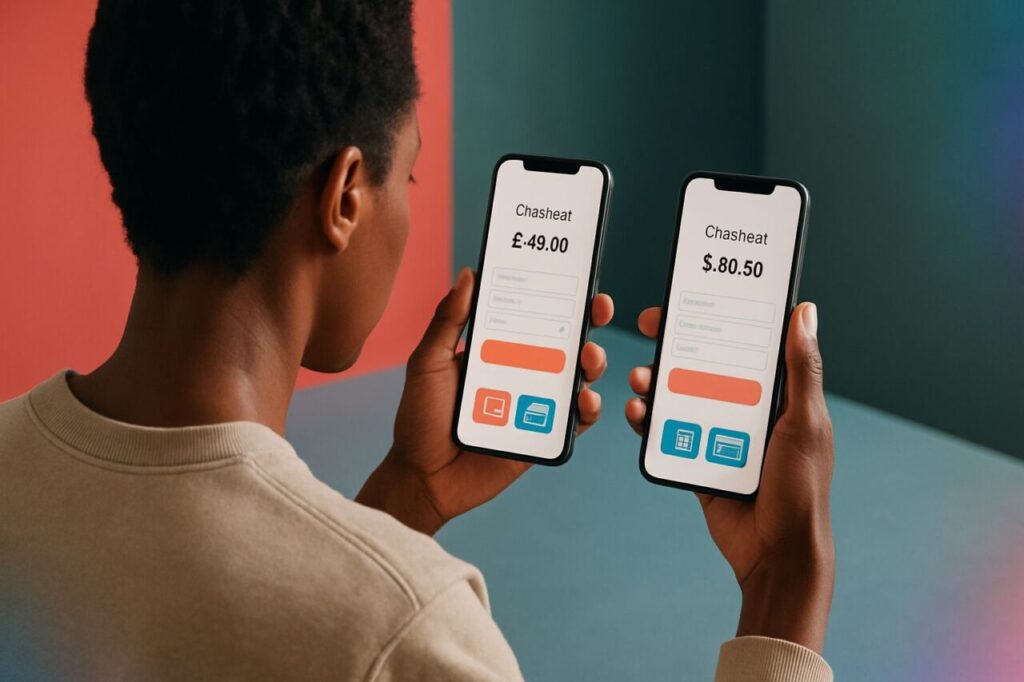
Your pricing policy must be clear in each context: prices in local currency, transparency on taxes and fees, and relevant payment options. Offering local payment methods isn’t a detail: it’s often the conversion tipping point. Analyses like the “State of Checkouts” report from Stripe or research from the Baymard Institute document how payment and checkout friction impacts conversion rates.
On the regulatory side, adapt legal notices, consent, and data processing (e.g., GDPR in Europe). Avoid internationalizing a single cookie or returns policy if it doesn’t match local expectations. A clear, market‑specific returns policy reassures as much as price.
Customer service and post‑purchase experience: the reality check
Selling is a promise; delivery is keeping it. Who replies, from where, and when? Display your support channels (chat, email, phone), response times, and response languages. Clarity on SLAs and availability is worth more than a vague promise. Logistics (timelines, tracking, customs, returns) should be explained without jargon. In some markets, a local point of contact or distribution partner boosts credibility.
Pragmatic method for SMBs: test, measure, iterate
For an SMB, ambition is funded by method. Avoid the “big bang.” Choose a pilot market, formulate hypotheses, then execute in short cycles:
- define your hypothesized product–market fit and KPIs (qualified lead, average order value, margin, LTV);
- localize key pages, proof, pricing, and checkout;
- launch a limited but measurable digital acquisition plan;
- analyze strong/weak signals and iterate on design, messaging, offer;
- equip sparingly (analytics, CRM, i18n QA) and automate only what adds value.
When the model holds, industrialize: playbooks, message libraries, reasonable automations, progressive budget. To scope an export project for North America: international marketing USA/Canada.
Translation is a deliverable. Understanding the market is a process. The first is easy to delegate; the second requires method, listening, and trade‑offs.
FAQ – common questions in international marketing
Do I need one site per country or a single multilingual site?
It depends on volume, content, and SEO needs. A single, well‑structured site (country folders /country/, hreflang, currencies) often suffices at the start. Separate sites help when offers, proof, partners, and channels diverge strongly by country.
Can I use AI to translate/localize?
Yes, to speed up first drafts, glossaries, and terminology QA. But native human review remains essential for nuance, tone, cultural codes, and respect for industry usage. AI is a support tool, not a strategy.
How should I choose the first market?
Cross internal data (inbound requests, partners, margin) with external signals (e‑commerce maturity, regulatory barriers, logistics). Macro indices like the UNCTAD B2C e‑commerce Index provide a framework, to be complemented by your field interviews.
Should I align my prices with local competitors?
Align the logic of pricing (positioning, benefits, cost to serve) more than the raw number. Test elasticity with bundled offers, guarantees, or premium services rather than margin‑destroying discounts.
Which content should I produce first?
Local offer pages, country‑specific case studies, proof (certifications, partners), purchase FAQs, returns policy, comparison guides, and a contextualized “About” page. Build topical authority: SEO / GEO and local interlinking.
Sources and references
- W3C Internationalization: i18n vs l10n — W3C
- UNCTAD – B2C E‑commerce Index — UNCTAD
- Ecommerce Checkout UX Research — Baymard Institute
- The State of Checkouts — Stripe
- Data protection in the EU (GDPR) — European Commission